Appealing a deportation decision
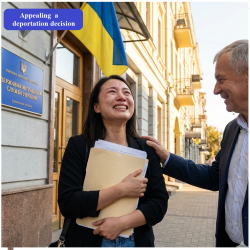
Challenging a Deportation Decision for a Foreign National
- Situation analysis and client consultation.
- Preparation of procedural documents.
- Representation in court.
- Monitoring the execution of court decisions.
28000.00 UAH

YOUR GOAL
Appealing a decision on the deportation of a foreign national
You are a foreign national who arrived in Ukraine for various reasons. Your documents were оформлены properly, however over time the validity period of a visa or other permit documents expires. In certain situations, state authorities may adopt a decision on deportation.
Typical problems faced by foreigners during deportation from Ukraine
Deportation is the forced return of a foreign national or stateless person to their country of origin or a third country on the basis of a decision issued by the State Migration Service, the Security Service of Ukraine, or the State Border Guard authorities.
In practice, foreigners face numerous legal, procedural, and humanitarian problems during the deportation procedure.
I. LEGAL AND PROCEDURAL ISSUES
1. Problems with appealing the decision
- Short appeal deadlines
Limited time to prepare a legal position and collect evidence.
- Lack of information about rights
Foreign nationals are not always properly informed about their right to judicial appeal.
- Language barrier
The deportation decision is served in Ukrainian without translation.
- Lack of free legal aid
The system of free legal aid for foreigners is effectively not functioning.
2. Documentation issues
- Absence of a passport or identity documents
Leads to prolonged detention in temporary holding facilities for foreigners (THF).
- Refusal by consulates to issue documents
Delays the deportation procedure and extends the period of detention.
- Difficulties in establishing nationality
Especially relevant for stateless persons.
3. Issues related to detention periods
- Uncertainty of detention terms
Detention may last up to 18 months without a specific deportation date.
- Exceeding maximum time limits
In cases where deportation is technically impossible.
- Lack of regular judicial oversight
There is no automatic review of the legality of continued detention.
II. CONDITIONS OF DETENTION IN TEMPORARY HOLDING FACILITIES (THF)
4. Living conditions
- Violation of minimum living space standards
Overcrowding, less than 4 sq. m per person.
- Unsatisfactory sanitary conditions
Poor sanitary and hygienic conditions of detention.
- Insufficient lighting and heating
Violation of basic living condition standards.
- Regime close to prison conditions
Strict restrictions on movement and isolation.
5. Food and daily necessities
- Low quality of food
Insufficient calorie intake and lack of dietary variety.
- Ignoring dietary needs
Religious or medical dietary restrictions are not taken into account.
- Lack of basic necessities
Insufficient hygiene products and clothing.
6. Medical care
- Limited access to doctors
Absence of permanent medical staff.
- Inadequate diagnostics
Lack of comprehensive medical examinations.
- Shortage of medicines
Especially for persons with chronic illnesses.
- Lack of psychological assistance
For persons with mental and emotional disorders.
III. PROTECTION OF THE RIGHTS OF FOREIGN NATIONALS
7. Access to legal assistance
- Limited access to a lawyer
Difficulties in arranging meetings and legal consultations.
- High cost of legal services
Most foreigners cannot afford legal representation.
- Lack of interpreters
Makes effective legal protection impossible.
8. Contact with the outside world
- Limited telephone communication
High cost of international calls.
- Restrictions on visits
Strict rules for relatives and legal representatives.
- No access to the Internet
Complicates communication with family members and lawyers.
9. Families and vulnerable groups
- Family separation
Deportation of one family member destroys the family unit.
- Detention of children in THF
Conditions do not meet the needs and best interests of the child.
- Insufficient protection of vulnerable persons
Victims of human trafficking are not properly identified.
- Violation of the principle of the best interests of the child
This principle is not taken into account when making decisions.
IV. FINANCIAL AND PRACTICAL ISSUES
10. Financial consequences
- Reimbursement of deportation costs
Additional financial burden on the foreign national.
- Loss of property and income
Employment, housing, and personal belongings.
- Inability to obtain compensation
Even in cases of unlawful detention.
11. Consequences after deportation
- Entry ban to Ukraine
For a period of up to 3 years.
- Inclusion in SIS databases
De facto ban on entry to EU countries.
- Risk in the country of origin
Risk of persecution, torture, or violence.
- Social disadaptation
Loss of social and family ties.
12. Systemic issues
- Lack of alternatives to detention
Bail, reporting obligations, or monitoring measures are not applied.
- Bureaucratic delays
Slow performance of state authorities.
- Corruption risks
On the part of public officials.
- Insufficient public oversight
Weak monitoring of human rights compliance.
CRITICAL VIOLATIONS
• Prolonged detention without judicial review (over 18 months)
• Detention in conditions that do not meet international standards
• Deportation to countries where there is a risk of persecution
• Family separation without considering the best interests of the child
• Lack of effective legal protection
WHAT SHOULD YOU DO?
1. Immediately contact a lawyer to protect your rights
2. Document all violations (complaints, applications, evidence)
3. Challenge the deportation decision in court
OUR OFFER
A comprehensive approach to resolving foreign national deportation issues
A professional law firm specializing in migration law and foreign entry to Ukraine can offer a wide range of services aimed at preventing entry refusals and effectively challenging negative decisions. A comprehensive approach includes both preventive measures and active legal actions to contest decisions that have already been adopted.
1. Preventive services (before crossing the border)
1.1. Legal audit of documents
Before planning a trip to Ukraine, the law firm conducts a detailed audit of the foreign national’s documents:
- Passport validity check. Analysis of the passport’s validity period, availability of required pages for visas and stamps, and compliance with minimum validity requirements after the planned stay.
- Visa requirements analysis. Determination of whether a visa is required depending on the foreign national’s citizenship, purpose, and duration of stay. консультации regarding the visa type that best matches the purpose of the visit.
- Assessment of financial support. Calculation of the required amount of funds in accordance with Ukrainian legislation and consultations on acceptable proof of financial means (bank statements, sponsorship letters, etc.).
- Medical documentation review. Consultations on the necessity of medical insurance and assistance in obtaining insurance policies that meet Ukrainian legal requirements.
- Preparation of supporting documents. Assistance in collecting and preparing documents confirming the purpose of travel: invitations, hotel reservations, tickets, confirmations from educational institutions, medical facilities, etc.
1.2. Migration history review
A law firm can assist in clarifying a foreign national’s migration history in Ukraine:
- Requests to state authorities. Official inquiries to the State Migration Service, the State Border Guard Service, and other authorities to obtain information on previous entries and exits, as well as any recorded violations.
- Check for existing bans. Determining whether the foreign national is listed in databases of persons banned from entering Ukraine and identifying the reasons for such a ban.
- Analysis of previous violations. If the foreign national has previously violated Ukrainian migration law, lawyers assess the possibility of lifting the ban or mitigating its consequences.
- Preparation of explanations. If there are problematic aspects in the migration history, lawyers help prepare persuasive explanations and supporting documents for border officials.
1.3. Consultations on migration law
- Legal analysis of the situation. A detailed review of the foreign national’s individual circumstances, identification of potential risks, and ways to minimize them.
- Explanation of rights and obligations. Informing the foreign national about their rights when crossing the border, staying in Ukraine, and in case problem situations arise.
- Behavioral recommendations. Advice on communication with border guards, providing correct answers to questions, and giving explanations.
- Emergency action plan. Preparation of step-by-step instructions in case of entry refusal or detention.
1.4. Preparation for a border interview
- Answer training. Conducting mock interviews to prepare for possible questions from border officials.
- Preparation of a document package. Creating a logically structured set of documents for presentation at the border.
- Briefing on common mistakes. Warning about the most frequent mistakes made by foreign nationals when communicating with the border service.
2. Services in case of detention at the border
2.1. Emergency consultations and representation
- 24/7 legal support. The ability to receive urgent legal advice from a lawyer at any time of day if problems arise at the border.
- Remote representation of interests. Communication between the lawyer and border officials by phone or video call to clarify the situation and protect the foreign national’s rights.
- Lawyer’s arrival at the border. If necessary, urgent arrival of an attorney at the checkpoint for in-person representation of the client’s interests.
- Support during the interview. Presence of a lawyer during questioning by border officials to ensure compliance with procedural rights.
2.2. Interaction with the border service
- Official requests and appeals. Preparation and submission of written requests to the State Border Guard Service regarding the grounds for detention and entry refusal.
- Negotiations with officials. Conducting negotiations with heads of checkpoints and other authorized officials to resolve the situation.
- Submission of additional evidence. Prompt provision of additional documents and explanations that may influence the decision of border officials.
- Drafting reports and statements. Assistance in properly preparing procedural documents and documenting violations of the foreign national’s rights.
2.3. Challenging an entry refusal
- Urgent administrative appeal. Filing a complaint with senior border service officials directly at the border.
- Preparation of legal positions. Drafting well-reasoned written objections to the decision refusing entry.
- Collection of additional evidence. Prompt obtaining and submission of additional supporting documents from Ukraine or the foreign national’s country of citizenship.
- Coordination with the inviting party. Communication with Ukrainian legal entities or individuals who invited the foreign national in order to obtain support.
2.4. Organization of alternative entry
- Searching for another checkpoint. Consultations on the possibility of entering through another checkpoint where the decision may differ.
- Preparation of a new document package. Refinement of the document set taking into account identified deficiencies.
- Support for re-entry. Organization of legal support during a repeated attempt to cross the border.
3. Services in case of a threat of deportation
3.1. Legal analysis of grounds for deportation
- Review of the deportation decision. A detailed legal analysis of the forced removal order, identification of procedural violations and errors.
- Assessment of the legality of the grounds. Verification of whether the stated grounds for deportation comply with Ukrainian legislation and international law.
- Identification of procedural violations. Analysis of compliance with procedural requirements when the deportation decision was adopted.
- Examination of case materials. Review of all documents on which the decision was based and identification of deficiencies in the evidentiary base.
3.2. Preparation of a defense strategy
- Collection of evidence of lawful stay. Building an evidentiary base confirming the legality of the foreign national’s stay in Ukraine.
- Documentation of ties with Ukraine. Collection of documents proving family ties, employment, education, business activities, and other circumstances demonstrating a close connection between the foreign national and Ukraine.
- Medical grounds. Obtaining medical opinions if the foreign national’s health condition does not allow deportation or return to the country of citizenship.
- Humanitarian circumstances. Documentation of circumstances that may justify the application of humanitarian exceptions (family, children, threats in the country of return, etc.).
3.3. Search for lawful grounds for legalization
- Analysis of residence permit options. Review of grounds for obtaining temporary or permanent residence in Ukraine.
- Preparation of legalization documents. Preparation and submission of documents for obtaining a visa, residence permit, or other authorization documents.
- Employment or business registration. Assistance with legalization through official employment or registration of entrepreneurial activity.
- Family reunification. Preparation of documents for reunification with family members who are Ukrainian citizens or have lawful residence status.
3.4. Petition for postponement of enforcement of the decision
- Preparation of a substantiated petition. Drafting a reasoned request for postponement of deportation with reference to legal grounds.
- Medical grounds for postponement. Obtaining medical opinions confirming the impossibility of deportation due to health conditions.
- Family circumstances. Documentation of family circumstances requiring postponement (serious illness of relatives, birth of a child, etc.).
- Judicial procedures. Filing a petition for postponement for the period of court review of an appeal against the deportation decision.
4. Challenging deportation decisions
4.1. Administrative appeal
- Complaint to a higher authority. Preparation and submission of a complaint to the management of the State Migration Service or another authority that adopted the decision.
- Preparation of legal arguments. Drafting a detailed legal justification for the unlawfulness of the deportation decision.
- Additional evidence. Collection and submission of new evidence that was not considered when the initial decision was made.
- Participation in the review of the complaint. Representation of the foreign national’s interests during the consideration of the complaint by the administrative authority.
4.2. Judicial appeal
- Filing an administrative lawsuit. Preparation and submission of a statement of claim to an administrative court seeking annulment of the deportation decision.
- Formation of an evidentiary base. Systematization of all evidence of the unlawfulness of the decision and preparation of documents for the court.
- Petition to suspend enforcement. Filing a motion to suspend enforcement of the deportation decision for the duration of the court proceedings.
- Representation in court. Full legal representation of the foreign national’s interests at all court hearings.
- Preparation of procedural documents. Drafting responses, motions, petitions, and other procedural documents.
- Involvement of experts and witnesses. Organizing the participation of experts, witnesses, and other persons to support the foreign national’s position.
4.3. Appellate and cassation review
- Appeal. Preparation and submission of an appeal against the decision of the court of first instance if it is unfavorable to the foreign national.
- Cassation appeal. Challenging decisions of the appellate court before the Supreme Court of Ukraine.
- Analysis of case law. Review of similar court decisions to develop the most effective legal position.
- Participation in hearings before higher courts. Representation of the client’s interests in appellate and cassation courts.
4.4. Applications to international bodies
- Preparation of an application to the ECtHR. If all national remedies have been exhausted, preparation of a complaint to the European Court of Human Rights.
- Application to UNHCR. In cases where deportation may pose a threat to the foreign national’s life or safety, submission of an application to the Office of the United Nations High Commissioner for Refugees.
- International human rights organizations. Engagement of international organizations to protect the foreign national’s rights.
5. Legal support during the forced removal procedure
5.1. Ensuring the rights of a foreign national
- Monitoring detention conditions. Oversight of the conditions of stay of a foreign national in a temporary detention facility for foreigners, identification of violations.
- Access to legal assistance. Ensuring unhindered access of an attorney to the foreign national throughout the entire period of detention.
- Access to medical care. Monitoring the provision of necessary medical assistance, filing motions for medical treatment.
- Communication with the consulate. Assistance in organizing contact with the consular institution of the foreign national’s country of citizenship.
5.2. Monitoring the legality of the procedure
- Verification of grounds for detention. Analysis of the legality of grounds for detaining a foreign national in custody prior to deportation.
- Control of time limits. Monitoring compliance with statutory detention periods and challenging their extension.
- Documentation of violations. Recording all violations of the foreign national’s rights for further appeals or applications to international bodies.
- Challenging unlawful actions. Immediate appeal against any unlawful actions or decisions of officials.
5.3. Organization of voluntary departure
- Negotiations on voluntary departure. Conducting negotiations with migration authorities regarding the possibility of voluntary departure instead of forced deportation.
- Organization of departure. Assistance with purchasing tickets and preparing the necessary travel documents.
- Selection of destination country. Consultations on choosing a country of departure if return to the country of citizenship is impossible or unsafe.
- Departure support. Organization of legal or representative сопровождение until the foreign national leaves Ukraine.
5.4. Protection of property rights
- Inventory of property. Preparation of an inventory of the foreign national’s property remaining in Ukraine.
- Organization of property safekeeping. Assistance in arranging safekeeping or transfer of property to authorized persons.
- Sale or transfer of property. Legal support for transactions involving the sale or transfer of property prior to deportation.
- Execution of powers of attorney. Preparation of powers of attorney for representatives to handle property matters after departure.
6. Removal of an entry ban to Ukraine
6.1. Legal analysis of the entry ban
- Clarification of the grounds for the ban. Obtaining official information on the reasons and duration of the entry ban.
- Analysis of the legality of the ban. Legal assessment of the compliance of the ban grounds with Ukrainian legislation.
- Assessment of cancellation possibilities. Evaluation of prospects for cancellation or reduction of the ban period.
- Development of a ban removal strategy. Formulation of an action plan aimed at lifting the entry ban.
6.2. Preparation of an application for removal of the ban
- Collection of supporting documents. Formation of a document package substantiating the need to lift the ban (family circumstances, employment, business, etc.).
- Drafting a substantiated application. Preparation of a detailed submission with legal justification for removing the entry ban.
- References and recommendations. Obtaining positive references and recommendation letters from Ukrainian organizations and institutions.
- Proof of absence of threat. Collection of evidence confirming that the foreign national does not pose a threat to national security, public order, or public health.
6.3. Administrative procedures
- Submission of an application to the migration service. Official submission to the State Migration Service of Ukraine requesting removal of the entry ban.
- Interaction with the Security Service of Ukraine and other authorities. Coordination with the Security Service of Ukraine and other bodies involved in decision-making.
- Support during application review. Monitoring the review process and providing additional documents upon request of the authorities.
- Negotiations with officials. Conducting negotiations to expedite the review process and achieve a positive decision.
6.4. Judicial procedures for lifting an entry ban
- Appealing a refusal to lift the ban. Filing a claim with an administrative court in case the application is rejected.
- Recognition of the ban as unlawful. Judicial protection in cases where the entry ban was imposed unlawfully or without proper grounds.
- Challenging the duration of the ban. Filing a lawsuit to reduce an excessively long entry ban period.
- Full legal representation. Handling the case in courts of all instances until a positive result is obtained.
When should you urgently contact professionals?
Critical situations requiring immediate legal assistance:
- You have been detained at the border — every minute matters! Border officers may make a final decision on entry refusal within a few hours. Without a lawyer, you risk receiving an entry ban for several years.
- You have been notified of a deportation decision — appeal deadlines are limited! Usually, you have only 10 days to file an administrative complaint. After this period expires, appealing becomes significantly more difficult.
- You received a notice of violation of migration legislation — this is the first step toward deportation. The correct response at this stage can completely prevent negative consequences.
- Your legal stay is about to expire — even one day of overstay may result in fines, administrative liability, and an entry ban. Act in advance!
- You were denied a visa extension or residence permit — you must urgently appeal the decision or find alternative legalization options before the forced removal procedure begins.
- You found out about an entry ban to Ukraine — the sooner the ban removal procedure starts, the higher the chances of success. Some bans can be lifted even before the established period expires.
Why is it important to contact lawyers right now?
- Time is working against you. Migration law establishes strict deadlines for appealing decisions. Every day of delay reduces your chances of success.
- Independent actions may worsen the situation. Incorrectly drafted documents, inaccurate explanations, or missed deadlines may lead to refusal of the complaint and complicate further defense.
- A professional approach increases the chances of success by 3–5 times. Experienced lawyers know all the nuances of migration law, court practice, and effective defense strategies.
- Comprehensive legal support saves your money. Resolving the issue at an early stage is much cheaper than dealing with the consequences of deportation and a long-term entry ban.
- Protection of your rights and interests. A lawyer will ensure compliance with all procedural rights and prevent abuse by officials.
- Psychological support. Deportation cases involve enormous stress. A professional lawyer will handle all legal matters, allowing you to focus on personal issues.
Do not risk your future in Ukraine!
If you are facing at least one of the situations listed above — contact professional lawyers right now.
The initial consultation will help you:
- Assess the real prospects of your case
- Determine the optimal defense strategy
- Calculate timelines and service costs
- Receive step-by-step instructions for immediate actions
- Regain peace of mind and confidence in the future
Remember: in migration cases, every hour counts. What seems hopeless today can be resolved in your favor by a professional lawyer — but only if you seek help in time.
Call right now to get urgent legal consultation!
DOCUMENTS
Documents required to appeal a deportation decision
Appealing a deportation decision requires thorough preparation of a complete document package. Below is a comprehensive list of required documents for various types of appeals and situations. Having all the necessary documents significantly increases the chances of a successful appeal.
1. Basic procedural documents for appeal
| № | Document | Notes |
|---|---|---|
| 1 | Copy of the deportation decision | Official decision on forced removal from the territory of Ukraine. Must contain the date of issuance, legal grounds, execution deadline, signature, and official seal of the authorized authority. |
| 2 | Foreign national’s passport | Copies of all passport pages, especially those with a photo, personal data, visas, and entry/exit stamps. The passport must be valid. |
| 3 | Copies of all submitted documents | Copies of the complaint and all attachments according to the number of parties involved in the case, plus one additional copy for the court or authority. |
2. Documents confirming lawful stay in Ukraine
| № | Document | Notes |
|---|---|---|
| 1 | Ukrainian visa | Copy of the valid visa or previous visas with entry/exit marks. It is important to demonstrate a history of lawful stay. |
| 2 | Temporary / permanent residence permit | If the foreign national has or had a residence permit — a copy of both sides of the permit. |
| 3 | Residence registration | Certificate from the State Migration Service or the detachable registration notification slip confirming the foreign national’s registered place of residence. |
| 4 | Documents on extension of stay | Applications, receipts, or decisions on extension of the permitted period of stay, if such requests were submitted. |
| 5 | Entry/exit stamps | Copies of passport pages with all border service stamps confirming compliance with migration regulations. |
| 6 | Invitation to Ukraine | Official invitation from a legal entity or individual, registered with the State Migration Service (if applicable), bearing the official seal and signature. |
3. Documents on family relationships and family reunification
| № | Document | Notes |
|---|---|---|
| 1 | Marriage certificate | Original or notarized copy of the marriage certificate with a Ukrainian citizen or a person legally residing in Ukraine. Foreign documents must have an apostille and translation. |
| 2 | Birth certificates of children | Birth certificates confirming parenthood. Especially important if the children are Ukrainian citizens. |
| 3 | Passport of family member (Ukrainian citizen) | Copy of the passport of spouse/parents who are Ukrainian citizens. |
| 4 | Certificate of family composition | Certificate from the place of registration confirming family composition and cohabitation. |
| 5 | Photographs of family events | Photos from weddings, birthdays, family gatherings confirming genuine family relations. |
| 6 | Joint financial documents | Lease agreements, joint bank accounts, utility bills at the same address. |
| 7 | Correspondence and calls | Printouts of correspondence and call history confirming long-term relationships. |
| 8 | Children’s medical records | Medical cards, vaccination records, and doctor visit certificates in Ukraine. |
4. Documents on work, education, and professional activity
| № | Document | Notes |
|---|---|---|
| 1 | Work permit for the foreign national | Official permit from the Employment Center authorizing employment of the foreign national in Ukraine. Must be valid. |
| 2 | Employment contract | Copy of the employment contract with a Ukrainian employer, certified with signatures and stamps. |
| 3 | Employer certificate | Certificate from the employer confirming the foreign national’s position, tenure, salary, and performance characteristics. |
| 4 | Tax documents | Income certificates, tax declarations, and statements of tax payments in Ukraine. |
| 5 | Education documents | Contract with educational institution, student ID, enrollment certificate, academic transcripts. |
| 6 | Business documents | Extract from the Unified State Register for a private entrepreneur or legal entity, charter, founding documents, licenses. |
| 7 | Bank statements | Bank account statements showing salary deposits or other evidence of financial activity. |
| 8 | Professional certificates | Diplomas, certificates, and licenses confirming qualifications and professional activity in Ukraine. |
5. Medical documents (for deferral or humanitarian grounds)
| № | Document | Notes |
|---|---|---|
| 1 | Medical certificate of health | Official certificate from a doctor confirming the presence of illnesses preventing deportation. Must have the medical institution’s stamp. |
| 2 | Medical commission conclusion | Conclusion from a medical commission about the impossibility of transporting the person due to health condition. |
| 3 | Medical record | Copies of the medical record documenting illness and treatment in Ukrainian medical facilities. |
| 4 | Prescriptions and medical orders | Prescriptions, physician orders, medication schedules. |
| 5 | Test results | Results of analyses, ultrasound, MRI, X-rays, and other medical examinations with dates. |
| 6 | Pregnancy certificate | For pregnant women – certificate from a gynecological clinic with pregnancy term and possible complications. |
| 7 | Disability certificate | MSCE conclusion regarding disability group and activity limitations. |
| 8 | Family member’s medical documents | Medical records of a close relative in Ukraine with a serious illness requiring the foreign national’s care. |
6. Financial documents (solvency and ties to Ukraine)
| № | Document | Notes |
|---|---|---|
| 1 | Bank statements | Statements from bank accounts for the last 3–6 months confirming financial solvency and legal income. |
| 2 | Income certificate | Certificate from workplace or tax office on income (form 2-PDFO). |
| 3 | Tax declarations | Copies of filed tax declarations for previous years with acceptance stamp. |
| 4 | Property documents | Ownership certificates for apartment, house, land in Ukraine, or lease agreements. |
| 5 | Vehicle documents | Vehicle registration certificate, technical passport confirming property ties to Ukraine. |
| 6 | Investment documents | Agreements on investments in Ukrainian enterprises, securities, bank deposits. |
| 7 | Payment documents | Receipts for utilities, rent, children’s education confirming residence in Ukraine. |
7. Documents for proving rights violations or illegality of the decision
| № | Document | Notes |
|---|---|---|
| 1 | Administrative offense protocol | If deportation was imposed as a sanction for an administrative violation – copy of the protocol, including any remarks by the foreign national. |
| 2 | Evidence of procedural violations | Any documents confirming procedural violations: lack of translator, insufficient time for defense, missed deadlines, etc. |
| 3 | Video or audio recordings | Recordings of communication with officials confirming rights violations or unlawful actions. |
| 4 | Witness statements | Written statements from witnesses or motions to summon them to court to confirm case circumstances. |
| 5 | Expert opinions | Conclusions of independent experts (lawyers, translators) on errors in the decision or violations of the law. |
| 6 | Judicial practice | Copies of court decisions in similar cases supporting your legal position. |
| 7 | International acts | References to ECHR decisions, conventions, international treaties protecting foreign national’s rights. |
8. Documents proving risk of persecution in the country of citizenship
| № | Document | Notes |
|---|---|---|
| 1 | Evidence of persecution | Documents confirming political, religious, or racial persecution: subpoenas, indictments, court sentences. |
| 2 | Reports from human rights organizations | Reports from international organizations (e.g., Human Rights Watch, Amnesty International) about the situation in the home country. |
| 3 | News articles | Articles from reputable media on repression, war, or natural disasters in the foreign national’s country of citizenship. |
| 4 | Medical evidence of torture | Medical reports documenting signs of torture or violence suffered in the home country. |
Challenging a deportation decision is a complex legal process where every detail matters. A single missing document, incorrectly formulated claim, or missed deadline can permanently close your path to Ukraine. An experienced lawyer not only knows the intricacies of the law but also has practical experience with successful cases. We turn legal uncertainty into a clear strategy with maximum chances of success.
Price
Challenging a Deportation Decision: Timeline and Service Costs
| № | Service Description | Timeline | Cost |
|---|---|---|---|
| 1 | Initial consultation: Analysis of the deportation decision, review of submitted documents, consultation, and development of an action plan. | 2 working days | € 200 |
| 2 | Preparation of documents and filing a lawsuit in court | from 10 days | Cost determined after initial consultation |
| 3.1 | Representation of the foreign national in court proceedings | from 6 months | Cost determined after initial consultation |
| 3.2 | Execution of the court decision | from 1 month | Cost determined after initial consultation |
We guarantee the final outcome – cancellation of the deportation decision.
@ ADDRESS
LAW COMPANY EUROVECTOR
City: Odesa
ADDRESS: St. Velyka Arnautska 45
Time of receipt: Monday - Friday 10:00АМ - 5:30РМ
Online
consultations: seven days a week 09:00АМ - 7:30РМ
Chat Center: seven days a week 09:00АМ - 9:30РМ
Registration for admission is carried out on the following contacts:
Phones:
+38 (094) 9973105
+38 (093) 1907047
+38 (098) 1891818
+38 (099) 5182838
Messengers: WeChat ID: eurovector2008
E-mail: [email protected]